


Maggiolino - Beetle
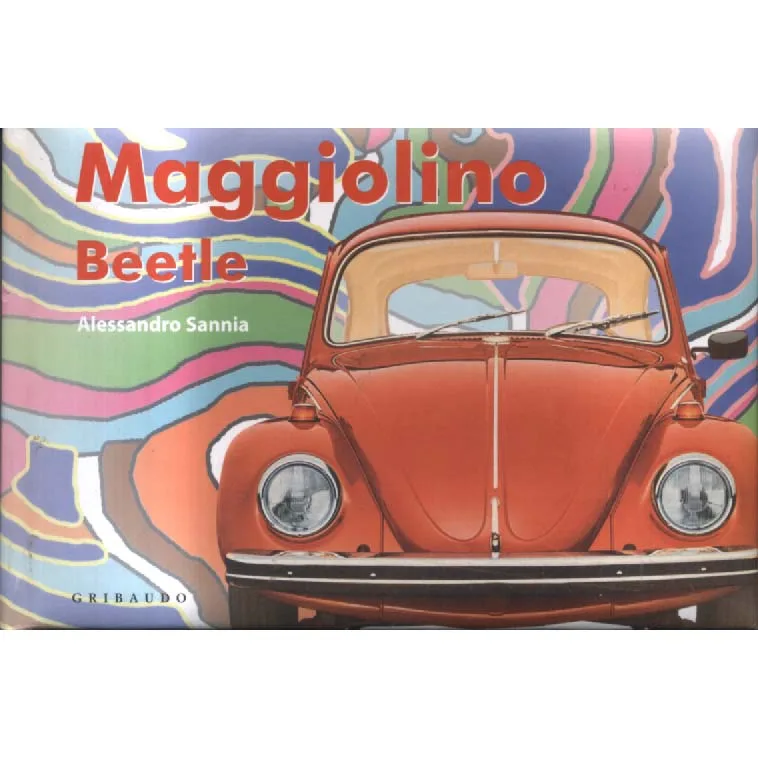
Publisher: Gribaudo
Format: Hardback
ISBN: 9788879063166
Maggiolino – Beetle (2007) by Alessandro Sannia
Gribaudo | ISBN: 9788879063166 | Condition: Good | Dual English–Italian Text | Padded Front and Back Covers
There are cars, there are classic cars, and then there is the Volkswagen Beetle, a machine that somehow managed to become one of the most recognisable, best-loved and relentlessly indestructible symbols of twentieth-century motoring despite looking rather like an unusually determined insect wearing a crash helmet. In Maggiolino – Beetle, published by Gribaudo in 2007, Alessandro Sannia celebrates the extraordinary history and enduring appeal of this remarkable little automobile, a vehicle that conquered the world not through spectacular performance, luxurious appointments or impressive technological sophistication, but by offering generations of motorists the reassuring possibility that they might actually reach their destination without spending their entire income on petrol and repairs.
The Beetle is one of the great automotive contradictions. It was designed to provide practical, affordable transport, yet eventually became a cultural icon. It was modest, mechanically uncomplicated and hardly a triumph of spacious interior design, yet millions of people developed an affection for it that owners of considerably more expensive automobiles could only dream of inspiring. It possessed neither the elegance of an Italian sports car nor the muscular confidence of an American V8, but somehow managed to acquire a personality more distinctive than practically anything else on the road.
And personality, as the Beetle demonstrates, can be considerably more important than horsepower.
The story of the Volkswagen Beetle begins in the politically turbulent Europe of the 1930s, when the idea of a practical and affordable people’s car became entangled with the ambitions of Nazi Germany. The vehicle’s early development is inseparable from this uncomfortable historical background, a reminder that even the most cheerful objects of popular culture can possess origins considerably darker than their later reputations suggest.
The engineering associated with Ferdinand Porsche helped establish the fundamental design that would eventually become familiar throughout the world: a compact car with an air-cooled rear-mounted engine, distinctive rounded bodywork and a mechanical arrangement that prioritised simplicity, durability and economical production.
The Second World War interrupted its development as a mass-market civilian automobile, but the post-war years saw the remarkable emergence of Volkswagen as a major international manufacturer. What had begun as an ambitious pre-war project developed into one of the most successful automotive products in history, transforming the Beetle from a modest German vehicle into a worldwide phenomenon.
For many families, the Beetle represented their first experience of affordable, dependable personal transport. It carried workers to factories, children to school, holidaymakers to the seaside and countless young couples towards futures that would probably have been considerably easier to negotiate if the back seat had possessed a little more room.
The Beetle’s appeal was partly practical. Its air-cooled engine avoided the complications of a conventional water-cooling system, its mechanical layout was relatively straightforward and its reputation for durability helped establish a loyal following. Owners learned to appreciate its particular habits, including the distinctive engine note, the unconventional driving characteristics and the curious fact that the engine was located precisely where many motorists expected to find the luggage.
This arrangement could cause confusion among the uninitiated, particularly when a helpful passer-by attempted to investigate a mechanical problem by opening the bonnet at the front and discovering an assortment of luggage rather than anything resembling an engine.
The Beetle also possessed a remarkable capacity to survive neglect, difficult roads and the attentions of owners whose understanding of vehicle maintenance extended little beyond occasionally checking whether there was still petrol in the tank. Naturally, the reputation for indestructibility was not entirely justified, as anyone who has spent several hours attempting to remove a rusted component from an elderly example will readily confirm. Nevertheless, the car earned a loyal following through a combination of practical engineering and the extraordinary availability of knowledge, parts and enthusiasm surrounding it.
Its appearance was equally important. The rounded roof, curved wings, circular headlights and compact proportions produced a shape so distinctive that even people with no interest in motor cars could identify one immediately. In an industry where manufacturers frequently imitate one another’s designs, the Beetle remained wonderfully unmistakable.
It was also a vehicle that seemed to possess a face. The headlights suggested eyes, the rounded bonnet gave it an almost cheerful expression, and the whole machine appeared to be smiling politely at a world of larger, faster and more aggressive automobiles. One could hardly imagine a Beetle being particularly threatening, even when driven by somebody whose enthusiasm exceeded their competence.
This friendly appearance contributed enormously to the car’s popularity, particularly during the 1960s and 1970s, when the Beetle became associated with youth culture, independence and an affectionate rejection of conventional automotive status symbols.
The American advertising campaigns for Volkswagen were especially memorable, turning the Beetle’s modest dimensions and unconventional appearance into positive selling points. At a time when many American manufacturers were producing enormous machines decorated with chrome, tailfins and enough metal to construct a respectable railway bridge, Volkswagen suggested that owning something smaller, simpler and less ostentatious might actually be rather sensible.
It was a magnificently subversive proposition. Instead of promising that a car would make its owner look wealthy, powerful or irresistible to members of the opposite sex, the Beetle’s advertising cheerfully acknowledged that the vehicle was small, economical and somewhat peculiar.
Naturally, millions of people loved it.
The Beetle’s cultural transformation reached extraordinary heights with the emergence of the hippie movement, when examples decorated with flowers, psychedelic patterns and peace symbols became familiar sights on American roads. A vehicle whose origins lay in one of the darkest periods of European history had become a symbol of peace, freedom, youthful rebellion and the rejection of material extravagance.
It is difficult to imagine a more remarkable reversal of cultural associations.
The Beetle also became a Hollywood star in its own right, most famously through the adventures of Herbie, the spirited little Volkswagen with a mind of his own and an extraordinary talent for outperforming vehicles that ought, by every reasonable mechanical calculation, to have left him several miles behind.
Herbie demonstrated that the Beetle possessed something most cars could only dream of acquiring: the ability to become a convincing fictional character without requiring an actor to sit behind the steering wheel and deliver any dialogue.
Of course, real Beetles were not generally capable of winning major motor races through supernatural enthusiasm, although their devoted owners occasionally behaved as though their vehicles possessed similar powers. The belief that a particular car has a personality is common among enthusiasts, but Beetle owners have elevated the practice almost to the level of religious conviction.
Cars acquire names, personalities and elaborate histories. Minor mechanical difficulties become charming eccentricities, rust is treated as evidence of character and a successful journey without incident may be celebrated as though the vehicle has personally overcome a significant moral challenge.
The air-cooled engine also contributes to the Beetle’s distinctive identity. Its unmistakable mechanical sound is familiar to enthusiasts around the world, a cheerful clattering accompaniment to journeys undertaken at speeds that seldom cause serious concern to the local constabulary.
There is something wonderfully appealing about a car that announces its presence without attempting to imitate a racing machine. The Beetle does not roar aggressively, thunder magnificently or emit carefully engineered electronic exhaust noises. It simply rattles along with the practical determination of a small agricultural machine that has been unexpectedly invited to participate in modern transport.
The model’s extraordinary production history is another essential part of its legend. Over the decades, the Beetle evolved through numerous mechanical and cosmetic changes while retaining the basic appearance and character that made it famous. Manufacturers introduced improvements, altered details and adapted the car to changing regulations and consumer expectations, yet the fundamental silhouette remained immediately recognisable.
By the time production of the original air-cooled Beetle finally ended in Mexico in 2003, more than 21 million examples had been manufactured, an astonishing achievement for a car whose essential design dated back to the 1930s.
Few automobiles have enjoyed such extraordinary longevity. Entire generations of competing models appeared, enjoyed their moment of popularity and disappeared into motoring history while the Beetle continued rolling off production lines with an admirable indifference to the passage of time.
It was almost as though somebody had forgotten to tell Volkswagen that the car was supposed to become obsolete.
The Beetle’s international success also created enormous communities of enthusiasts, restorers and collectors. Across Europe, North America, South America and elsewhere, examples survive in every imaginable condition, from immaculate concours restorations to heavily modified machines that bear only a passing resemblance to the original design.
Some owners insist upon preserving every factory detail with obsessive precision, carefully researching original paint colours, trim specifications and production changes. Others enthusiastically modify their cars, fitting larger engines, lowered suspension, custom wheels or elaborate bodywork, apparently regarding the original Volkswagen design as merely an interesting starting point.
Both approaches contribute to the car’s enduring fascination, although a committed originality enthusiast encountering a radically modified Beetle may experience approximately the same emotional reaction as a medieval historian discovering that somebody has fitted neon lighting to a Norman cathedral.
The Volkswagen Beetle also occupies an important position in the history of automotive design because it demonstrates that commercial success does not necessarily depend upon constant reinvention. For much of its production life, the car remained fundamentally true to its original concept, relying upon familiarity, affordability and the loyalty of its customers.
Modern automotive manufacturers, who frequently introduce entirely new models with enormous publicity campaigns and complicated electronic features, might find this persistence slightly disturbing. The Beetle managed to sell in extraordinary numbers while possessing an interior whose principal technological attractions included a steering wheel, a speedometer and, eventually, enough additional equipment to satisfy the modest demands of twentieth-century motorists.
Yet the simplicity was part of its appeal. Drivers developed an intimate relationship with the machinery, learning its characteristics and frequently undertaking maintenance tasks themselves. The car encouraged mechanical understanding in a way that modern vehicles, with their sealed electronic systems and elaborate diagnostic requirements, do not always permit.
There was a time when changing a component on a Beetle might require little more than basic tools, patience and a willingness to get one’s hands dirty. Modern motorists, by contrast, may discover that replacing a seemingly straightforward electrical component involves connecting the vehicle to a computer, obtaining specialist software and making a financial commitment comparable to a modest weekend holiday.
Of course, nostalgia should not entirely obscure the limitations of the original Beetle. By modern standards, its performance was modest, its heating arrangements could be unpredictable and its crash protection belonged to an era when safety engineering had not yet acquired its present sophistication. Long motorway journeys could be noisy, winter motoring required determination and the car’s handling characteristics demanded respect, particularly from drivers accustomed to more conventional mechanical arrangements.
But these limitations are precisely what make the Beetle such an interesting historical vehicle. It belongs to a period when motoring involved a more direct relationship between driver and machine, when mechanical simplicity was valued and when the experience of travelling could be just as memorable as the destination.
For many owners, the Beetle became far more than an ordinary means of transport. It accompanied important moments in their lives, carried them through formative experiences and accumulated memories that survived long after the vehicle itself had been sold or scrapped.
First cars, family holidays, student adventures, romantic excursions and innumerable ordinary journeys contributed to the personal histories attached to millions of Beetles. Few models can claim such a universal emotional connection with their owners.
And then there is the charming linguistic distinction reflected in the title of this book. In Italy, the Beetle became affectionately known as the Maggiolino, a name that seems wonderfully appropriate for a small, rounded automobile resembling an industrious little insect. The English nickname Beetle possesses a similar warmth, avoiding the elaborate numerical designations and aggressive marketing language favoured by many modern manufacturers.
There is something rather delightful about a car whose international reputation is based upon its resemblance to a small creature usually encountered crawling around the garden.
Published by Gribaudo in 2007, Alessandro Sannia’s Maggiolino – Beetle is an appealing celebration of this remarkable motoring phenomenon, bringing together the Italian and English identities of one of the world’s most beloved cars.
The book features text in both English and Italian, making it particularly interesting to an international audience of Volkswagen enthusiasts, collectors of automotive literature and readers who appreciate motoring history presented from more than one linguistic perspective.
The bilingual format is especially appropriate for a vehicle whose appeal extended far beyond its German origins. The Beetle became a genuinely international automobile, embraced by motorists with different languages, cultures and motoring traditions, all united by a shared affection for its curious appearance and mechanical character.
Indeed, the car itself might be regarded as a particularly successful example of international communication. A Volkswagen Beetle rarely needs translating. Its shape, sound and cheerful personality are understood almost everywhere, even if the owner occasionally has difficulty explaining to a foreign mechanic why the heating system has suddenly decided to stop cooperating.
This particular edition also possesses an attractive physical feature that distinguishes it from a conventional automotive paperback: padded front and back covers.
There is something rather luxurious about a padded book devoted to a car famous for its economy, simplicity and relatively modest appointments. The vehicle itself was never especially renowned for lavish interior comfort, yet here is a volume celebrating its achievements while enjoying the sort of soft exterior treatment that early Beetle owners might have appreciated on their seats.
The padded covers give the book an appealing tactile quality and make it an attractive object in its own right, particularly for collectors who enjoy unusual book formats, carefully presented automotive volumes and publications that possess a little more personality than the average reference work.
One might even suggest that the book is better cushioned than some of the original cars it describes, although attempting to test this proposition by sitting on the volume would be strongly discouraged.
The combination of its bilingual presentation, distinctive padded binding and subject matter makes this edition especially suitable for collectors of Volkswagen literature, enthusiasts of vintage automotive design and admirers of the Beetle’s extraordinary cultural history.
It also has considerable gift potential. Almost everybody knows somebody who has owned a Beetle, wanted a Beetle, restored a Beetle or spent an unreasonable amount of time explaining why the original air-cooled design represents one of humanity’s finest mechanical achievements.
Such individuals are generally delighted to receive another reminder of their favourite automobile, particularly when it does not involve the expense of purchasing replacement body panels or investigating a suspicious patch of corrosion beneath the rear seat.
The Beetle’s enduring popularity is ultimately a reminder that the most successful designs are not necessarily the most technically advanced or commercially extravagant. Sometimes a product achieves lasting significance because it possesses a distinctive character, satisfies an important practical need and becomes woven into the everyday experiences of millions of people.
The Volkswagen Beetle did all of these things, transforming a modest economy car into an international symbol of motoring history, popular culture and mechanical individuality.
This 2007 Gribaudo edition is offered in Good condition by Crappy Old Books, complete with its distinctive padded front and back covers and dual English–Italian text.
The book is a particularly appealing addition to a collection of motoring literature, offering the pleasures of Volkswagen ownership without requiring a garage, specialist mechanical knowledge or the discovery that a small amount of visible rust conceals approximately three square feet of missing metal.
Unlike the actual car, it does not require petrol, insurance, an annual service or a carefully maintained stock of spare parts. It is also considerably easier to park, occupies less room than a Volkswagen engine and should remain perfectly reliable regardless of the outside temperature.
An excellent gift for Beetle owners, Volkswagen collectors, motoring historians, enthusiasts of classic European cars or anyone who appreciates the distinctive charm of an automobile that spent decades proving that small, simple and slightly peculiar could also mean enormously successful.
A delightful celebration of one of the most recognisable cars ever built, presented in English and Italian and housed in an unusually appealing padded-cover edition that offers a little extra luxury to the story of a famously modest motor car.
And perhaps the greatest achievement of the Volkswagen Beetle was persuading the world that an economical little car could become an object of genuine affection, surviving changes in fashion, technology and public taste while retaining its instantly recognisable personality.
Modern manufacturers spend millions attempting to create precisely this sort of emotional connection, often through elaborate advertising campaigns involving beautiful landscapes, dramatic music and actors pretending that driving a family hatchback represents the ultimate expression of personal freedom.
Volkswagen, meanwhile, managed much of the same thing with a car shaped like a beetle.
Crappy Old Books: celebrating the great classics of motoring without requiring a restoration budget, a supply of engine oil or a lengthy discussion about whether the indicators are original.
And remember, should you ever decide to purchase a real Volkswagen Beetle after reading this book, the acquisition price may prove surprisingly reasonable.
It is everything you discover underneath the paintwork that should concern you.
At least the book’s padded covers are meant to be soft.
Keep browsing: See more Transport books Other books by Alessandro Sannia
